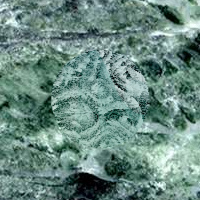
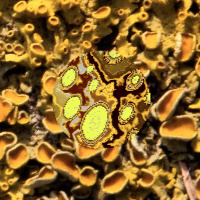
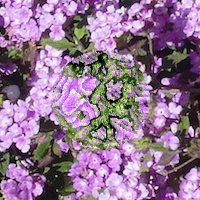
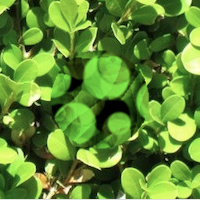
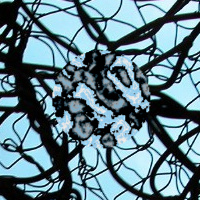
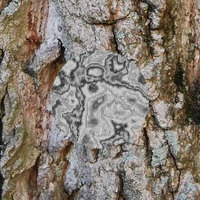
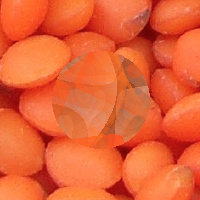
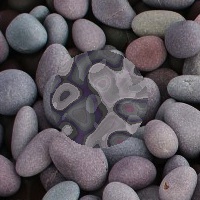
Camouflaged circular “prey” overlaid on the background image for which they evolved: polished serpentine stone, yellow lichen, lantana flowers and leaves, green hedge, twisty wire against sky, tree bark, orange lentils, pebbles.
Abstract:
This article presents an abstract
computation model of the evolution of camouflage in nature. The 2D
model uses evolved textures for prey,
a background texture representing the environment,
and a visual predator. A
human observer, acting as the predator, is shown a cohort
of 10 evolved textures
overlaid on the background texture. The observer clicks on the five
most conspicuous prey to remove (“eat”) them. These lower-fitness
textures are removed from the population and replaced with newly bred
textures. Biological morphogenesis is represented in this model by procedural
texture synthesis.
Nested expressions of generators and operators form a texture
description language. Natural evolution is represented by genetic
programming (GP), a variant
of the genetic algorithm. GP
searches the space of texture description programs for those that
appear least conspicuous to the predator.
Paper in the Artificial Life journal:
Craig Reynolds. 2011. Interactive
Evolution of Camouflage. Artificial
Life 17(2). doi:10.1162/artl_a_00023
--
[PDF, 0.9 MB]
An earlier version of this paper
appeared at the ALife XII
conference in Odense, Denmark: Craig Reynolds. 2010. Interactive
Evolution of Camouflage. In the
proceedings
of the 12th
International Conference on the Synthesis and Simulation of Living
Systems (ALife XII),
August 2010. [PDF, 3.6
MB]
Poster at SIGGRAPH 2010, July 25-29, Los Angeles, California:
Craig Reynolds. 2010. Using Interactive
Evolution to Discover Camouflage Patterns. ACM SIGGRAPH 2010 Posters [DOI]
One page summary (PDF, 0.3 MB)
Slides presented at EE380 (Computer Systems Colloquium), October 6, Stanford University:
This is a slightly revised and expanded
version of the slides presented at ALife XII.
Please
note: no derivative works. While you are welcome to copy or
share this presentation as a whole, any other use of the photographs
within it may
require explicit permission of the photographer. This is particularly
true of images marked with the copyright symbol and used here by
permission. If you seek
permission, contact me for
more information.
Presentation Slides (PDF, 33 MB(!))
Additional images:
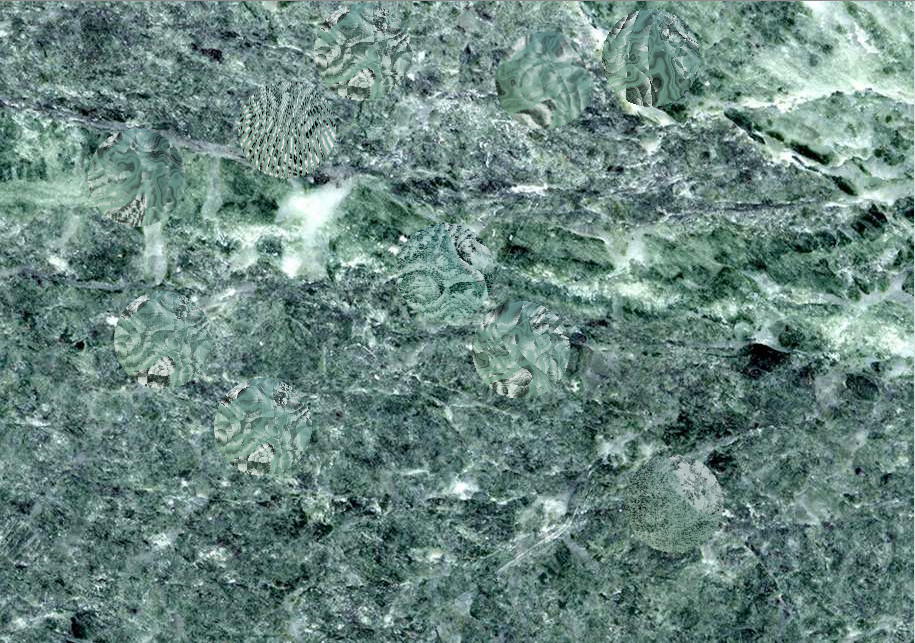
Screen capture of interactive evolution
session with the “serpentine”
environment. A cohort of ten evolved camouflage textures are displayed
overlaid on the background image (a photograph of polished stone).
Image
galleries
showing time series of changes during simulated
evolution. Some show
the computer
application's entire window
including the entire background image overlaid with a cohort
of ten camouflaged prey.
Others show thumbnail images
of an individual prey on a portion of the
background. These are listed with best results at the top and worst
results at the bottom:
Addendum / Errata:
The paper failed to specify a
significant parameter: the size of evolved prey. The circular prey were
100 pixels in diameter. The “thumbnail” images of
individual prey (top of this page) show a 200 by 200 pixel rectangle of
the background
image with a 100 pixel diameter prey centered on it.
Related links:
Experiments using this goal
oriented
texture synthesis technique in graphic arts
The library used to represent and
render the textures used in this work: Texture
Synthesis
Diary
A 2008 proposal
for a larger research project, of which this is the first step.
Last update: September 28, 2013, Craig Reynolds